Key Takeaways:
- Five European countries (Iceland, Ireland, Netherlands, Slovenia, Spain) boycotted the 2025 Eurovision over Israel's participation
- The contest's liberal values are under scrutiny as it struggles to balance inclusivity with political reality
- A new rules package aimed to limit government-backed campaigns but failed to resolve the core controversy
- The crisis reflects broader tensions in the rules-based international order
VIENNA — On May 9, the day before the Eurovision Song Contest held its opening ceremony, protesters were already in the streets. Israel's participation, a fact of Eurovision since the country joined in 1973, had become a flash point after the war in Gaza began in 2023.
What began as calls from artists and activists for Israel's exclusion transformed into an open revolt. Five countries announced they would not attend. Numerous former contestants boycotted, and the 2024 winner, Swiss singer Nemo, returned their trophy to the European Broadcasting Union (EBU) — rumored to be smashed and wrapped in toilet paper.
If this seems melodramatic, that's because the contest's troubles represent not just a song competition under threat, but a global order teetering on the edge of collapse. Eurovision, long a symbol of the liberal internationalist project, finds itself in danger of being caught up in its demise.
Eurovision's Contradictory Identity
Eurovision is the world's most-watched non-sports broadcast. Founded by public broadcasters after World War II, the contest aimed to stitch the continent back together under values of "universality, diversity, equality, and inclusivity."
These high-minded aspirations are achieved, of course, through choreography, pyrotechnics, and enough sequins to make Liberace blush.
The tension between pan-European public square and flashy campfest is core to Eurovision's identity. The same sparkly competition that launched ABBA has also featured a Portuguese protest song against dictatorship, a Bosnian number about European indifference to genocide, and a winning song about Stalin's forced deportations from Crimea — performed two years after Russia's invasion did the same to the singer's family.
When the EBU excluded Russia after its 2022 invasion of Ukraine, then-executive supervisor Martin Österdahl explained: "What we always should stand up for are the basic and ultimate values of democracy."
The Israel Dilemma
This is why Israel's participation has presented such a problem. The controversy heightened after Israel came in second last year in Basel, Switzerland. Had the country won, per the rules, it would have hosted this year — effectively getting a weeklong advertisement partly funded by the EBU.
As Natalija Gorscak, head of the boycotting Slovenian broadcaster RTV, told me: "Killing 20,000 children in Gaza is the same as killing the children in Ukraine for me. No war should be tolerated."
The EBU avoided an up-or-down vote on Israel at its General Assembly in November. Instead, it paired the question with a rules package designed to tamp down on controversial tactics Israel employed in its attempt to win.
- New rules discourage government-backed advertising campaigns
- Public votes limited to 10 per payment method
- Boycotting broadcasters felt the hedge was unsatisfying
"There were two questions in one, and they were quite contradictory," Gorscak said.
A Contest for Stability, Not Values
I arrived at Eurovision to find a contest moving away from its values-based self-conception. Vienna, this year's host, served as the perfect backdrop. The city was the center of a very different Concert of Europe — the 19th-century international system focused more on stability than values.
One Austrian official's remark about the Congress of Vienna could apply to this year's contest: "It dances, but it does not progress."
Eurovision's director, Martin Green, pushed back against calls for Israel to drop out, arguing that Eurovision is not a competition of countries but of public broadcasters. Russia's broadcaster was a propaganda outlet, while Kan, the Israeli broadcaster, is independent.
This argument doesn't track with Eurovision history. Nothing changed about Russia's broadcaster in 2022, when it was kicked out. As Österdahl said then, the Russian delegation "had not broken any rules, but it became unsustainable because we have a rule that says you must not bring disgrace over the competition."
The separation between country and broadcaster became even harder to defend when the New York Times reported that Israeli embassies had been calling foreign broadcasters to advocate for Israel's inclusion. Israeli Prime Minister Benjamin Netanyahu seems to disagree with Green's technical distinction.
Inside the Arena: Politics Silenced
Inside the arena for the semifinals, the contest tried to forget the controversy outside. Audiences were awkwardly encouraged to participate in a pre-show kiss cam and clap along to a techno remix of "Volare." Security threw out a protester for chanting "Free Palestine."
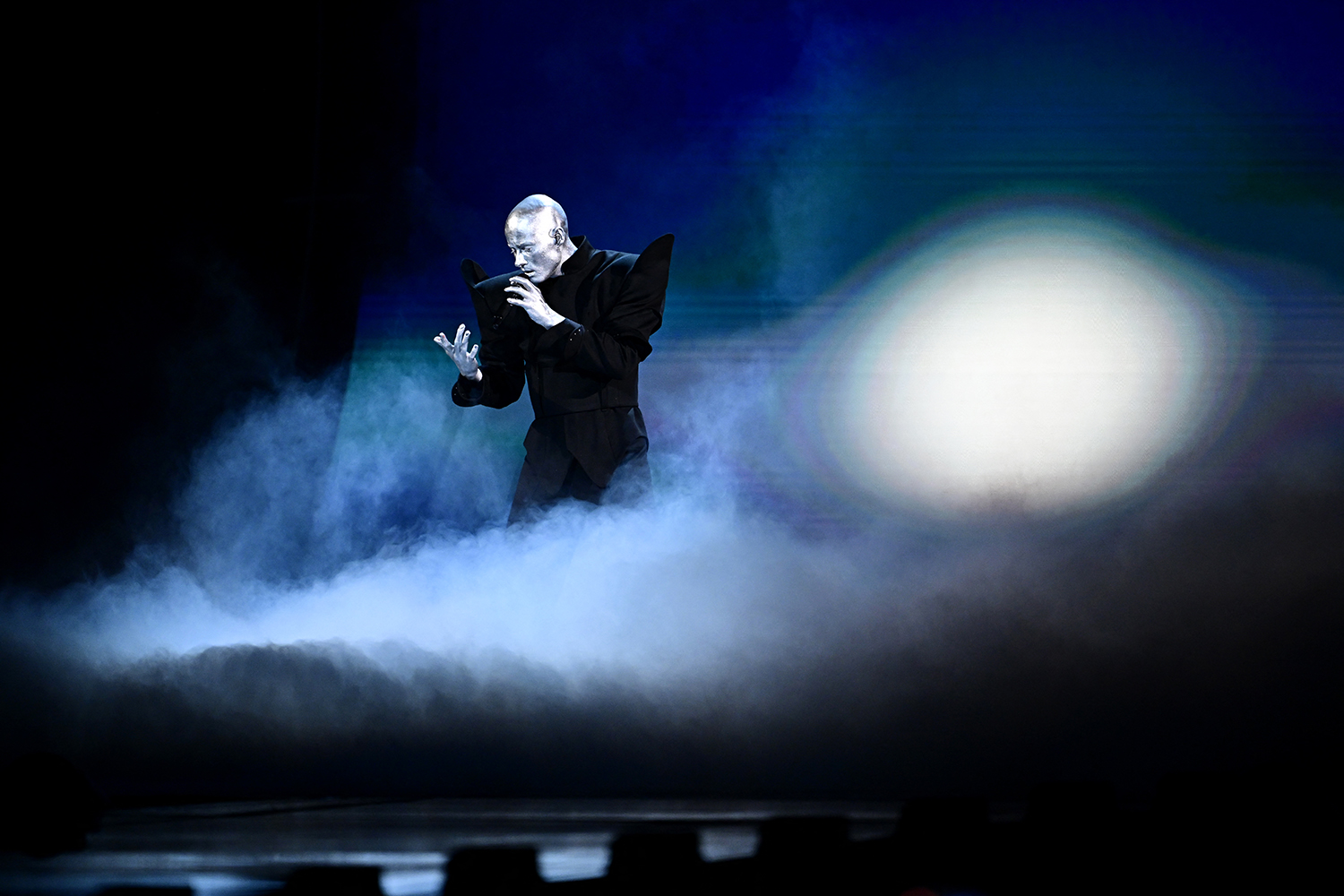
Musical acts steered studiously clear of politics. One exception was Lion Ceccah, a prominent Lithuanian drag artist, who appeared onstage painted in silver performing a dystopian number.
Lion Ceccah's selection speaks to Eurovision's ability to influence national identity. Lithuania sent its first openly LGBTQ+ representative to the contest in 2024. Since then, it has repealed a law prohibiting LGBTQ+ "propaganda."
But when I brought up previous contestants' comments about the difficulties of competing with Israel, Lion Ceccah hesitated. "I don't wanna talk a lot about politics because I'm not allowed, actually," he said, referring to new rules against artists "instrumentalizing" the contest.
Green sees these rules differently: "We 100 percent believe in free speech." Yet this distinction wasn't communicated to all delegations — more than one press representative told me discussing politics was against the rules.
The Absentees Speak Volumes
As quiet as current contestants were, the absence of those from years past spoke volumes. Irish singer Linda Martin, a Eurovision fixture since winning in 1992, was notably absent. She linked Ireland's past to its sensitivity to Palestinians: "When you consider what the Troubles were like in Ireland for years, that could have made people step back."
Three of the five boycotting nations — Ireland, Slovenia, and Spain — have a history with authoritarian or colonial forces cracking down on national movements. The Catalonian case is part of Eurovision history: In 1968, Spain's Franco regime prevented Joan Manuel Serrat from performing in Catalan.
Eurovision's Geopolitical Future
At protest concerts across Europe, artists felt freer to engage with politics. Palestinian singer Bashar Murad, who nearly represented Iceland at Eurovision 2024, performed in Brussels.
"My whole participation was a conceptual art piece," Murad said. "It was about the journey of me going from Palestine and jumping through so many hoops and obstacles to be heard."
Now, he seems to think the moment has passed. "The competition has been hijacked and compromised. It has become a tool for Israel."
Eurovision's retreat from its values comes at a pivotal moment. The week ended with the contest pushing the launch of Eurovision Asia, including South Korea, Thailand, and Vietnam — but not China or India, both of which joined Putin's recently relaunched Intervision, a Cold War-era competitor that bills itself as apolitical.
Some still believe Eurovision can represent liberal international community. Canadian Prime Minister Mark Carney is working with the CBC to explore joining. Hungary's new prime minister, Peter Magyar, has said he will bring the country back.
The Grand Final: Bulgaria Wins
The Grand Final ended in a tense battle between Israel and Bulgaria. The arena erupted in boos when Israel's high televote score was reported, but Bulgarian singer Dara came out on top with "Bangaranga."
That Eurovision will be hosted next year by a country that recently gained Schengen membership and adopted the euro suggests there may be some life left in the contest's values-based approach.
Dara described her song as being about the sense that "everything is possible." It's a feeling that both Eurovision and the postwar project desperately need.