Key Takeaways
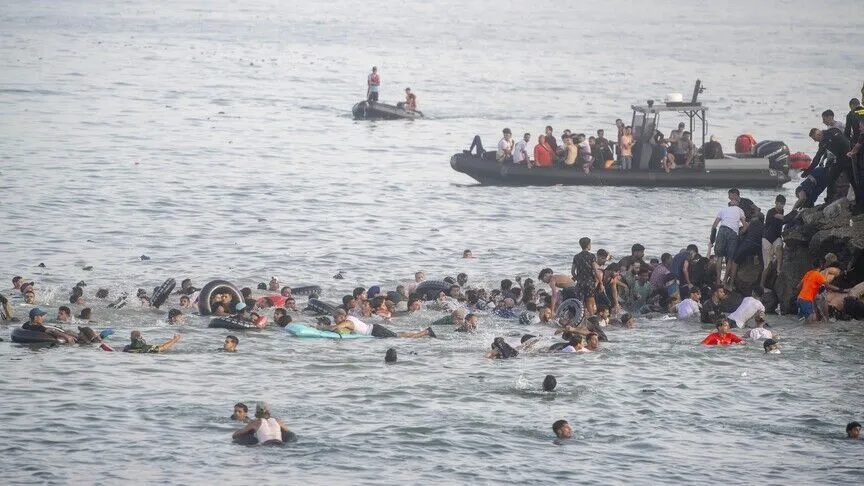
- Over 60,000 people crossed into Ceuta in 72 hours, a population surge of 70%, with 72 deaths at the Tarajal breakwater.
- Morocco orchestrated the border breach, reversing it within days via a bus fleet, signaling a deliberate pressure tactic.
- US think-tank fellows and a congressman publicly outlined a plan to pressure Spain over Ceuta and Melilla, months before the crisis.
- The motive appears to be punishment for Spain's defiance of US policy on Iran and NATO spending, with the Strait of Gibraltar as the strategic prize.
- The crisis aimed to fracture European unity, with France, Italy, and EU officials blaming Spain rather than Morocco.
A Tide That Was Commanded
For three days at the end of July, the Mediterranean gave up a grim harvest at Tarajal. Seventy-two bodies emerged from the water, most of them young men and children, crushed or drowned while attempting to reach the Spanish enclave of Ceuta. Within 48 hours, more than 48,000 of the living had turned back into Morocco, a retreat as sudden as the surge.
Between 50,000 and 60,000 people crossed into Ceuta in 72 hours, swelling its population by 70% before draining away. Spanish Prime Minister Pedro Sánchez called it an "attack" and sent in the army. But a crowd of 60,000 doesn't gather like weather. It gathers because people are told where and when. The summons ran across social networks, converging on Fnideq, the border town facing Ceuta. In a state as heavily policed as Morocco, none of it went unseen.
The proof lies eleven months back. In September 2024, a similar summons failed when Moroccan riot police dispersed the crowds. The border held because Rabat decided it would. This time, reporters watched Moroccan soldiers wave the men through. Spanish police unions used a harder word: blackmail. Then Rabat proved its control by assembling a fleet of buses overnight to empty the border town. A government that can charter a bus fleet can close a road. Passivity was the weapon.
A Blueprint from Washington
The method had been set down in advance. On March 12, Michael Rubin, a senior fellow at the American Enterprise Institute and former Pentagon official, called on Donald Trump and Marco Rubio to recognize Ceuta and Melilla as occupied Moroccan territory. Spain, he wrote, remains a "colonial power." The grievance: Sánchez had recalled Spain's ambassador from Israel and kept silent on Iran. Recognition would right a historical wrong, on the model of Trump's recognition of Moroccan sovereignty over the Western Sahara.
Four days later, Rubin urged Morocco to launch a "second Green March" into the enclaves, sending unarmed civilians with bulldozers. He preemptively disarmed the NATO objection: Article 6 excludes territory south of the Tropic of Cancer. "Neither Ceuta, Melilla, nor the Canary Islands would trigger a NATO response." A former Pentagon man had priced the alliance's silence into the plan.
Within a month, the method had a congressional sponsor. On April 1, Mario Díaz-Balart, the Republican of Florida who chairs the House subcommittee funding American diplomacy, told the Spanish daily El Español that the enclaves are "not in the geographic territory of Spain" but "in the territory of Morocco." In three weeks, the annexation of two pieces of Europe had traveled from a think-tank column to an appropriations chairman.
Why Spain, Why Now
The motive was both explicit and structural. Spain had refused the US use of its Rota and Morón bases for strikes on Iran, closed its airspace to American aircraft, and rejected NATO's 5% spending target. Trump promised to make Madrid pay, by name: "Cut off all trade with Spain, please, including visits."
But trade with Spain is settled in Brussels, by the European Commission, for all 27 members at once. No American president can tariff Spain alone. The weapon was blunted. What remained was the border—belonging to Spain alone, facing a kingdom that owed Washington and wanted the enclaves. The tariff was off the table. The border was on it.
The Network's Own Testimony
In April, the Israeli news site Ynet carried an analysis by Amine Ayoub, a fellow of the same Middle East Forum that ran Rubin's appeals, titled "Abraham Accords reach the Strait: how Israel can help Morocco reclaim its north." Ayoub set out three channels for Israel to press Rabat's claim: direct diplomatic signaling, amplification through Washington, and public shaming. Then he wrote the line that closes the distance: helping Morocco take the enclaves would serve the Abraham Accords and punish a NATO member that had chosen obstruction over partnership.
Morocco, he noted, holds the key to one of the world's vital maritime chokepoints. The same piece laid out the scaffolding: a joint military work plan with Israel, a fresh defense roadmap with Washington, and an internal Pentagon email weighing Spain's suspension from NATO. No order need be cut, no meeting held. The incentive was published, in English, across three countries, over six weeks.
The Response: Europe Turns on Itself
Within hours of the breach, the US State Department blamed Madrid, not Rabat, citing Spain's "deliberate efforts" to enable illegal migration. Trump called the drownings a talking point for the midterms. Then Europe did exactly what the design required. France ordered new checks on its Spanish border. Italy imposed its own. Senior figures called for Spain's suspension from Schengen, and the European Commission president, looking upon the dead, reminded Spain to honor the rules.
The reaction was the product, not a by-product. Threat and scarcity were the levers, and the word "invasion" fused them into a single picture. The politicians demanding expulsion performed, without pay, the fracturing the operation existed to cause.
One man refused the part written for him. Sánchez did not blame Morocco. He kept the diplomatic line open, crediting Moroccan forces with clearing the crowds. His restraint was not innocence but discipline—he grasped that the crossing aimed at his standing in Europe as much as at his fence. To blame Rabat would hand his attackers the rupture they were engineering. His contempt he saved for the "selfish, polarizing and unlawful reaction" of European allies.
A Mechanism Already in Motion
Stand back, and Ceuta becomes a method. Washington holds a structural interest in a fractured Europe, dependent rather than free. The repeated tell: a fracture sold as security that leaves the fractured more dependent. Against Iran, sanctions and strikes. Against Russia, severed energy ties that hiked European dependence on American gas. Across the Middle East, the Abraham Accords realigned a region about a Washington-Jerusalem axis. Now, the Strait.
The same think tank, on August 2, while bodies were still being drawn from the sea, called on Israel to support independence for New Caledonia, France's Pacific territory. The template holds: find an exposed possession, dress its severance as righting a historical wrong, and let the loss fall on a European state judged insufficiently obedient.
The Prize Beyond the Seam
Ceuta sits on the Strait of Gibraltar, the western door of the Mediterranean, through which passes a quarter of the world's shipping. The Ynet writer named the chokepoint, not the enclaves, as the prize. The seventy-two dead are what a quarrel over airspace looks like when a superpower reaches through the sea. Rabat has done this before, in 2021. What is new in 2026 is the script: written in Washington, named in Tel Aviv, published months ahead.
The panic is real in its effect but manufactured in its origin. The drowned were real. The crisis was not found; it was made. The record of its making sits in the open—on the letterhead of a think tank, a newspaper, and a congressional office—waiting for someone to set the pages side by side and read the dates in order.