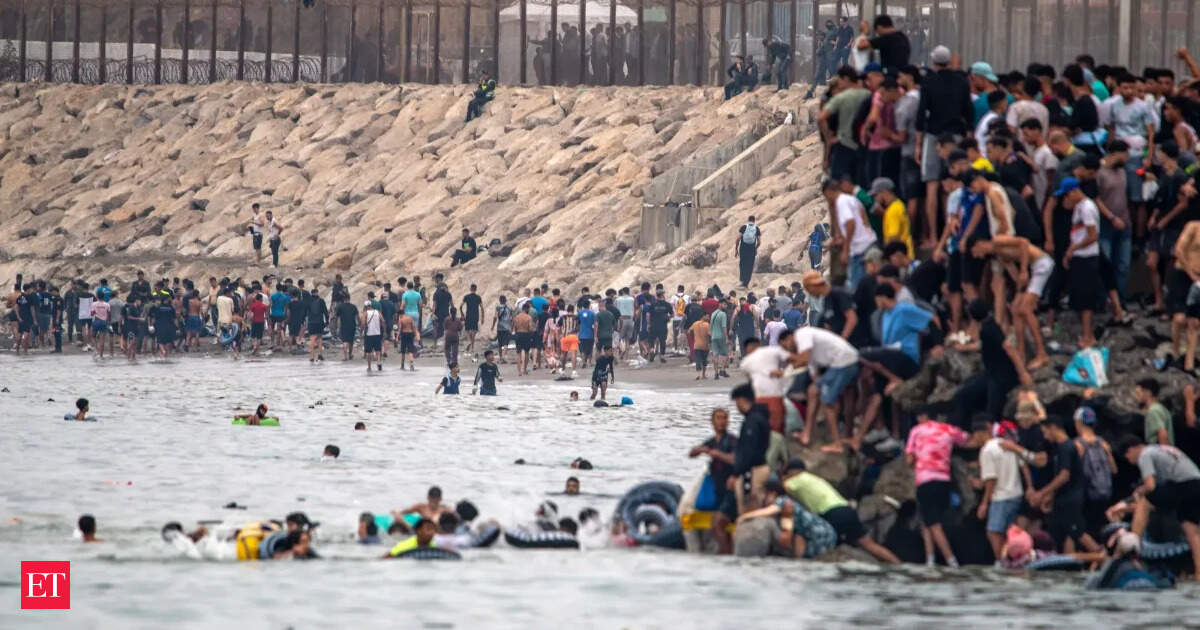
The Spanish enclave of Ceuta has become the epicenter of a humanitarian catastrophe, as the death toll from last week's mass crossing attempt by migrants from Morocco has risen to at least 72, with officials recovering five more bodies off the North African coast on Sunday.
This tragedy, which unfolded in the span of just a few days, has sent shockwaves through the European Union, exposing deep divisions over how to manage migration at the bloc's only land borders with Africa.
"It pains me deeply that young people are dying at sea. It's not right that, in the year 2026, women with children as young as two months old should be crossing the sea only to die," said Karima Abenaz, a French national in Ceuta with family in Morocco, her voice breaking with emotion.
A Sudden and Unprecedented Surge
Starting on Thursday, more than 50,000 people, mostly Moroccans, attempted to enter Ceuta by land and sea, exploiting lax border enforcement and social media rumors that falsely suggested Spain had opened its doors to irregular migrants. The numbers dwarfed any previous migration wave, overwhelming local authorities and causing alarm across European capitals.
Within 48 hours, over 48,000 people were returned to Morocco, and thousands more followed over the weekend. However, the human cost has been staggering: some drowned while trying to swim around the breakwater, others were crushed in the chaos as crowds pushed to climb the border fence, and many were reportedly injured in clashes with security forces.
Death Toll Discrepancy Amid Conflicting Reports
The discrepancy between the numbers offered by Moroccan and Spanish officials remains a point of contention. Morocco's Interior Ministry put the death toll at 11, mostly from drowning, and claimed that 40,000 people attempted the crossing, a figure far lower than the one cited by Spanish authorities.
Ceuta's local leader, Juan Jesus Vivas, told Spanish newspaper El Pais that the city's morgue had received 88 bodies, including those who had died in earlier, smaller attempts over the past two weeks. He added that Moroccan authorities were also recovering bodies from the sea, but no official data had been shared.
"The situation in the enclave has improved markedly," said Miguel Angel Perez, the Spanish government representative in Ceuta, "but more remains to be done to re-establish full normality."
A Blame Game Over Root Causes
Moroccan authorities have pointed to social media misinformation and human trafficking networks as the main drivers, echoing accusations from Spain's Foreign Ministry. In particular, they criticize a Spanish court ruling that barred immediate returns of migrants intercepted at sea, which they say was misinterpreted and encouraged crossings.
Spain, for its part, has rejected any suggestion that its recent programme to regularize more than half a million undocumented migrants contributed to the surge. Spanish officials stress that those who entered Ceuta irregularly cannot travel to mainland Spain or anywhere else in the Schengen zone, a key point aimed at discouraging migrants.
EU Under Pressure: A Fragile Unity
The incident has prompted 22 EU member states to write a letter demanding coordinated action to protect external borders and to address the broader migration challenge. In a symbolic move, Italy suspended the passport-free Schengen agreement with Spain for one month, a measure that underscores the fragile trust among member states.
This tragedy highlights the complex realities of migration in the Mediterranean region, where economic desperation often collides with border security imperatives.
- Economic despair: Many migrants are driven by the lack of job opportunities in Morocco, despite the country's relative stability.
- Trafficking networks: Criminal groups capitalize on desperation, spreading false promises and charging exorbitant fees.
- Border management: The event exposes the vulnerability of even the most fortified EU borders.
What's Next for Ceuta and the EU?
As Ceuta attempts to return to some semblance of normality, the beach remains guarded by floating barriers and additional police patrols. The broader questions, however, linger: How can the EU reconcile its values of openness with the need for security? And what can be done to address the root causes of migration before more lives are lost?
The growing chorus of voices, both from within the enclave and from across the bloc, is now calling for a more humane and coordinated approach to migration. For now, the waters off Ceuta serve as a grim reminder of the desperation that pushes people to risk everything, and the profound costs when policies fail.