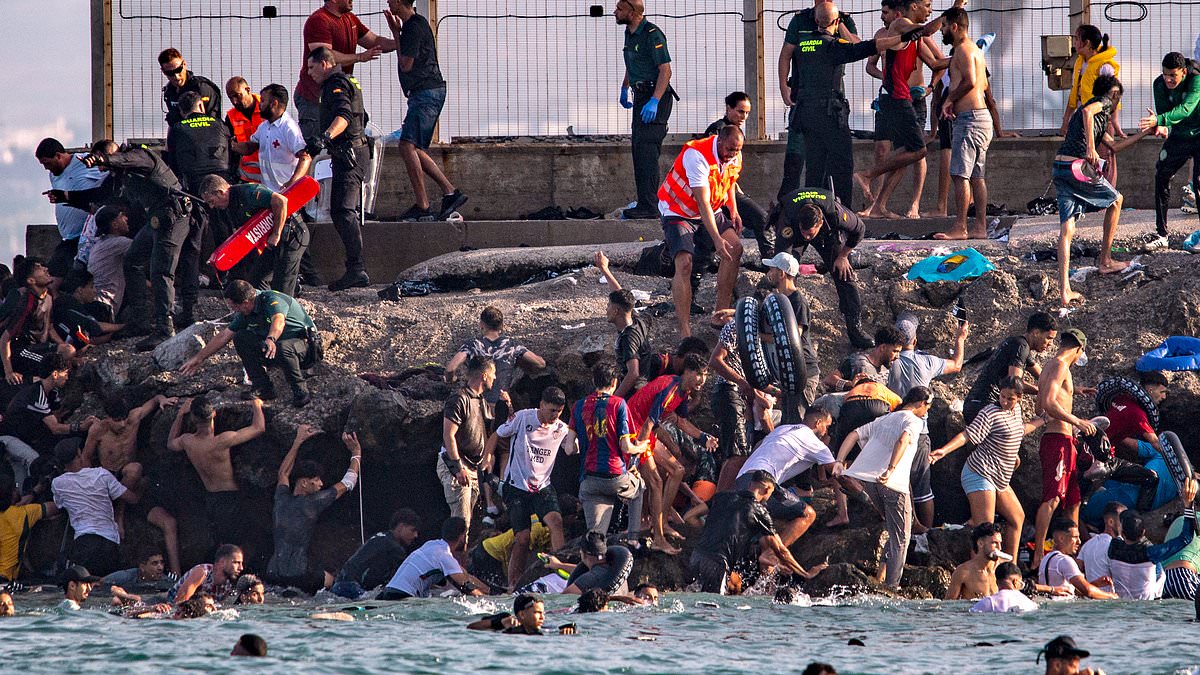
Key Takeaways:
- A mass influx: An estimated 20,000 migrants entered the Spanish enclave of Ceuta from Morocco on Thursday, triggering a state of emergency.
- Legal link: Spanish police unions point to a recent Supreme Court ruling that restricts summary returns of migrants arriving by sea, calling it a 'pull factor'.
- Political fallout: Italy threatens to suspend Schengen with Spain, while Madrid deploys the army to restore order.
- Human cost: At least 18 people died attempting the crossing on Thursday, with local facilities overwhelmed.
Unprecedented Swell Overwhelms Ceuta
The normally quiet Spanish enclave of Ceuta saw chaos erupt on Thursday as thousands of migrants, mostly from Morocco and Algeria, swam around border fences or bypassed security posts to storm into the territory. Footage shows crowds cheering and shouting 'Long live Spain!' as they reached Spanish soil, while others attempted to break into homes after nightfall.
The Spanish government estimates 20,000 people entered in a single day, making this the largest irregular entry into Spain in its history. Local officials describe a city of around 84,000 residents now struggling to cope with an influx that has saturated reception centers and stretched security forces to their limits.
The Supreme Court Ruling That Changed Everything
A key factor in this surge, according to Spanish police unions, is a recent Supreme Court decision that tightened restrictions on migrants intercepted at sea. The court ruled that those arriving by water cannot be 'summarily returned' across the border without due process, unlike those who climb the land fence.
The Unified Police Union argues this creates a 'pull factor,' stating that the surge came 'after the Supreme Court rejected border rejections, complicating deportations.' The ruling effectively offers a more legal path to remain for those who come by sea, incentivizing the dangerous swim.
However, activists like Omar Naji of the Moroccan Association of Human Rights doubt this legal technicality drove the masses, suggesting most migrants would have little awareness of such rulings.
A City Under Siege
By evening, migrants were seen trying to break into homes across Ceuta, with local media reporting a Moroccan couple using a ladder to smash a first-floor window. Terrifying footage shows crowds rushing into open doors as residents cower on balconies.
Business owners like Enrique Serrano, who runs a women's clothing store, have shut their doors. 'I'm not opening this afternoon because the situation is extremely tense... The first thing I have to do is protect my business and my family,' he told Reuters.
The territorial president, Juan Jesus Vivas, declared a 'total humanitarian and social emergency,' noting that facilities for unaccompanied minors are at 2,400 percent capacity. He added that at least 60 bodies have been recovered at sea in recent months.
Spain's Response: Army Deployment and Denials
Madrid has dispatched 200 specialized police officers and 60 troops to reinforce the enclave. At the same time, the central government refuses to declare a national emergency, arguing that migration crises do not justify such a measure—a decision that has angered local officials.
Spain's foreign ministry denies that a recent regularization plan for 500,000 undocumented migrants is linked to the surge, saying such status requires proof of residency before January 1, 2026.
Schengen Under Threat?
Italy's Prime Minister Giorgia Meloni has threatened to suspend the Schengen Area with Spain, saying the images from Ceuta show 'uncontrolled illegal immigration poses a concrete threat to the security of Europe's borders.' Her foreign minister echoed the call, claiming Spain's open-door approach encourages smuggling.
The EU has offered Frontex deployments and financial aid, while UN Secretary-General António Guterres insists on respecting the rights of arriving migrants.
The Mounting Toll
Spain's Civil Guard, maritime rescue, and the Red Cross have been plucking swimmers from the sea all day. At least 18 people died trying to reach Ceuta on Thursday alone, officials confirmed. The Mediterranean route remains one of the deadliest, with dozens of bodies washing up on Spanish shores in recent months.
As the crisis escalates, questions arise: Will the Supreme Court ruling hold? Can Spain secure its borders without violating human rights? And will the EU's unity fracture under pressure? The coming days will be critical for Ceuta, for Spain, and for the future of Schengen.